
Key takeaways
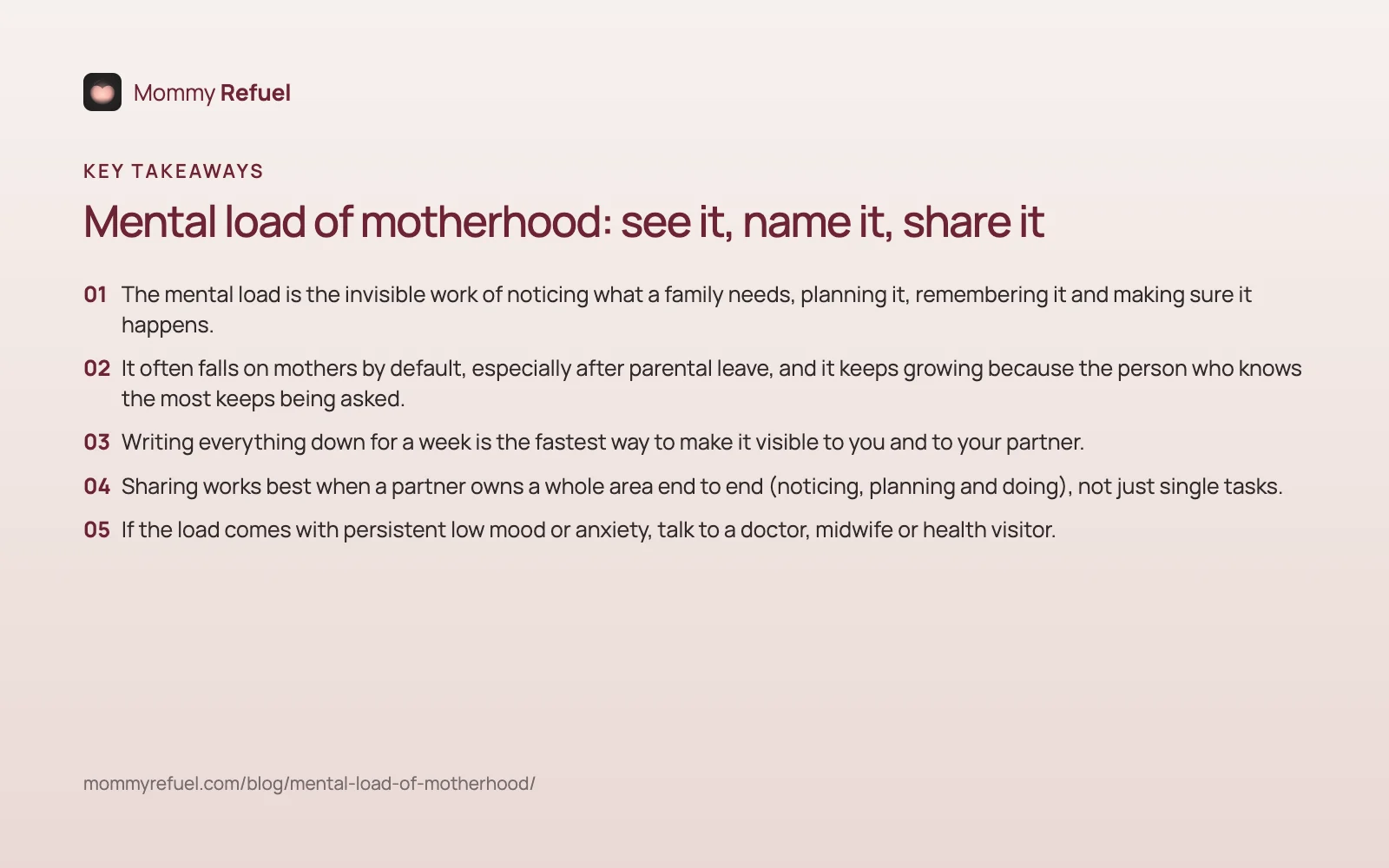
- The mental load is the invisible work of noticing what a family needs, planning it, remembering it and making sure it happens.
- It often falls on mothers by default, especially after parental leave, and it keeps growing because the person who knows the most keeps being asked.
- Writing everything down for a week is the fastest way to make it visible to you and to your partner.
- Sharing works best when a partner owns a whole area end to end (noticing, planning and doing), not just single tasks.
- If the load comes with persistent low mood or anxiety, talk to a doctor, midwife or health visitor.
What is the mental load?
The mental load is the thinking work behind running a family. It is not just doing the laundry. It is noticing the basket is full, remembering that the school uniform needs to be clean by Monday, knowing the washing powder is almost out and adding it to the list.
It includes things like:
- Remembering appointments, vaccinations, birthdays and school forms.
- Knowing which clothes sizes your children are in and when they will need the next ones.
- Planning meals and noticing what is running low.
- Keeping track of everyone's feelings, friendships and moods.
- Anticipating what could go wrong and preparing for it.
Most of this work is invisible. When it is done well, nothing happens: nobody runs out of nappies, nobody misses the dentist. That is exactly why it is so easy to overlook, and so tiring to carry.
Why does the mental load usually fall on mothers?
Often nobody decides it. It just happens. During pregnancy and the first months, mothers are usually the ones reading, booking appointments and learning the baby's rhythms, especially if they take more parental leave. Knowledge builds up in one person, so that person is the one everyone asks. The more you know, the more you are asked, and the gap keeps widening.
Cultural expectations play a part too. Many of us grew up watching our own mothers hold everything together, and a partner may genuinely not see the work because they were never the one doing it. This is rarely about bad intentions. It is about a system that runs quietly through one person's head.
Signs your mental load is too heavy
- You are the only one who knows where things are or what is coming up this week.
- Your partner helps, but only when you ask, and asking feels like another job.
- You lie awake running through lists.
- You feel resentful about small things and then guilty for feeling that way.
- Rest does not feel restful because your mind never switches off.
Carrying too much for too long is one of the common roads to exhaustion and burnout, so it is worth addressing before it spills over.

How to make the mental load visible
It is hard to share something nobody can see. Start by getting it out of your head.
Do a one-week brain dump
For seven days, write down every task, reminder and worry the moment it pops up. Use a notes app or paper by the kettle. Include the small things: texting the grandparents, checking the nursery menu, buying a gift for a party.
Sort it into areas
Group the list into areas such as meals and food shopping, laundry, health and appointments, school or nursery, social life and gifts, money and bills, home and repairs.
Notice the three layers
For each area, there are three parts: noticing that something is needed, planning how it will happen, and doing it. Very often one partner does the doing while the other still carries the noticing and planning. That hidden part is the mental load.
Sharing the load beyond a partner
Not every mother has a partner, and even with one, a family can need more hands. Grandparents, friends, neighbours and other parents can take whole areas too: a regular school run, a weekly meal, being the person who handles birthday gifts for a season. Thinking of these people as a small Care Circle can make it easier to ask without feeling like a burden.
It also helps to let go of some things altogether. Not every task needs an owner. Some can simply stop.
When the load is more than logistics
Sometimes the mental load comes with something heavier: a low mood that will not lift, constant anxiety, trouble sleeping even when you can, or feeling hopeless. If this lasts more than two weeks, please talk to your doctor, midwife or health visitor. If you have thoughts of harming yourself or your child, contact your local emergency services straight away. You deserve support, not just a better system.
Questions mothers ask
What is an example of mental load?
Noticing your child has almost outgrown their shoes, remembering to measure their feet, finding a time to buy new ones and adding it to the week's plan. Buying the shoes is the task; everything before it is the mental load.
Is the mental load the same as housework?
Not quite. Housework is the doing. The mental load is the noticing, planning, remembering and organising that make the doing happen, and it often stays with one person even when chores are shared.
How do I explain the mental load to my partner?
Write down everything you track for one week and share it calmly, without blame. Then explain that the tiring part is not only doing tasks but having to remember and delegate them.
What if my partner says they would help if I just asked?
That offer is kind, but asking is itself part of the load. Suggest that they take full ownership of one area, including noticing when something is needed.
How can single mothers reduce the mental load?
Share whole areas with trusted people, such as a regular school run or weekly meal, simplify routines and let some tasks go. Writing everything down also frees up headspace.
Sources

Articles from the Mommy Refuel team: practical, honest reading on maternal wellbeing and family life. General information, never a substitute for professional care.
This article is general information for wellbeing, not medical advice, diagnosis or treatment. If you are worried about your health or your baby’s, talk to your doctor, midwife or health visitor. In an emergency, or if you have thoughts of harming yourself, contact local emergency services now.