
Key takeaways
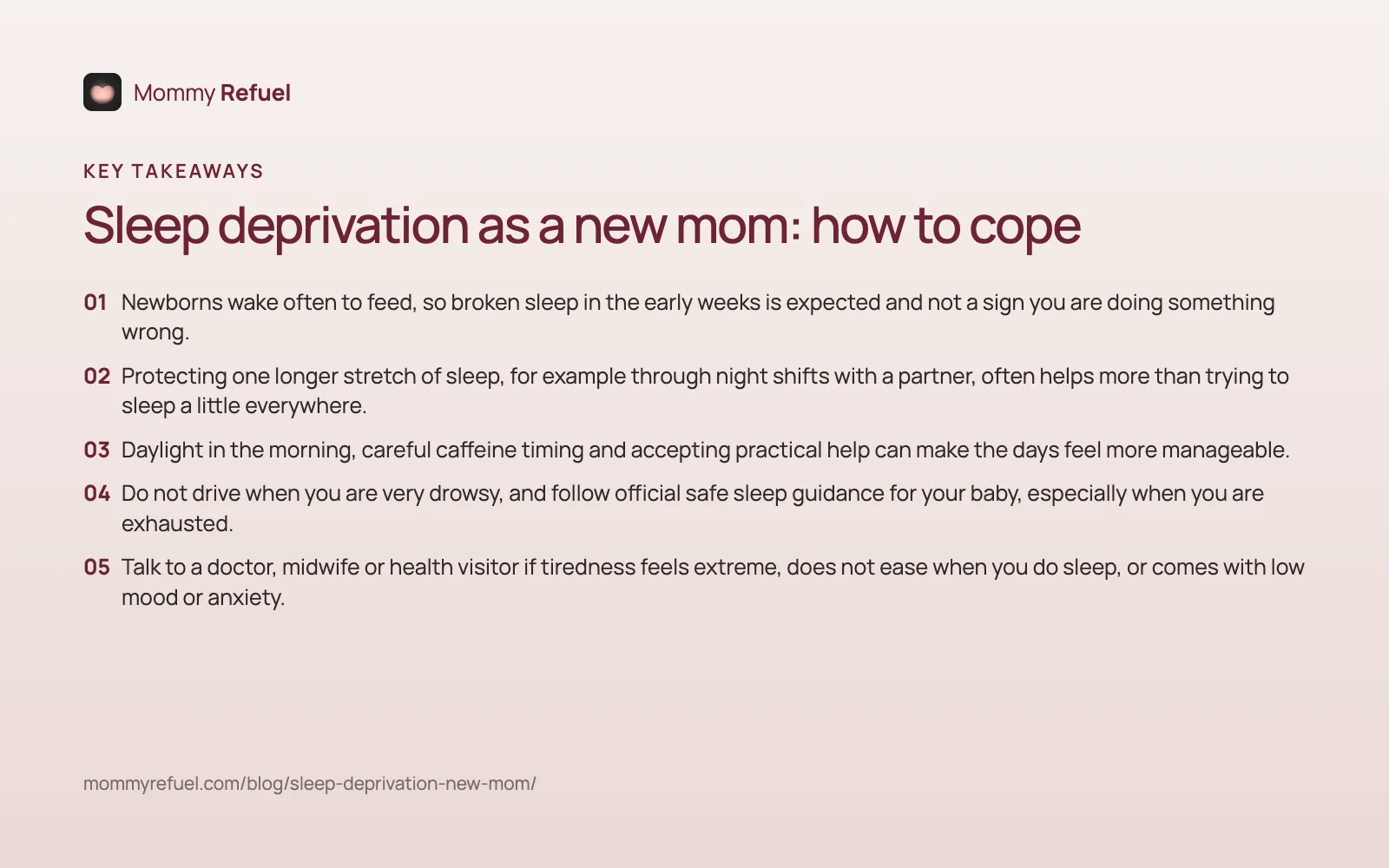
- Newborns wake often to feed, so broken sleep in the early weeks is expected and not a sign you are doing something wrong.
- Protecting one longer stretch of sleep, for example through night shifts with a partner, often helps more than trying to sleep a little everywhere.
- Daylight in the morning, careful caffeine timing and accepting practical help can make the days feel more manageable.
- Do not drive when you are very drowsy, and follow official safe sleep guidance for your baby, especially when you are exhausted.
- Talk to a doctor, midwife or health visitor if tiredness feels extreme, does not ease when you do sleep, or comes with low mood or anxiety.
Why are the newborn weeks so exhausting?
Newborns have tiny stomachs and need to feed around the clock, so they wake frequently through the night. On top of that, your body is recovering from pregnancy and birth, hormones are shifting, and your own sleep is often light because you are listening for your baby. It is not only the total hours that suffer. The constant interruptions break up your sleep cycles, which is why even eight scattered hours in bed can leave you feeling drained.
Short-term sleep loss commonly affects concentration, memory, patience and mood. Knowing this can take away some of the self-blame. If you feel foggy, tearful or irritable after a run of hard nights, that is a very human response to sleep loss, not a personal failing.
The good news is that for most families this phase changes as babies grow and feeds gradually spread out. In the meantime, the aim is not perfect sleep. It is enough rest to stay safe, steady and kind to yourself.
Can you protect one longer stretch of sleep?
Many parents find that one longer, uninterrupted block of sleep feels more restoring than several short naps. If you have a partner or another adult at home, it can help to plan the night together rather than both waking for every feed.
Ideas for night shifts
- Split the night. One person covers the first half of the night while the other sleeps in a quiet room, then you swap.
- Share the jobs around feeds. If you are breastfeeding, your partner can handle nappy changes, settling and bringing the baby to you, so you can go straight back to sleep.
- Consider an expressed or formula feed. Some families use one bottle feed given by a partner to protect a longer stretch. If you are breastfeeding, a midwife, health visitor or feeding specialist can help you think through timing.
- Use earplugs or white noise when you are off duty, so you are not half-listening all night.
If you are parenting solo, a longer stretch may still be possible on certain nights when a relative or friend can stay over. Even one or two protected nights a week can make a noticeable difference.
How can naps, light and caffeine help during the day?
The classic advice to sleep when the baby sleeps is not always realistic, but some daytime rest is still worth protecting. Try to choose at least one of your baby's naps as your own rest time, and let other tasks wait.
- Keep naps simple. Lie down somewhere dark and quiet. Even if you do not fall asleep, resting with your eyes closed can help.
- Get daylight in the morning. Natural light early in the day helps your body clock, which can make it a little easier to fall asleep when you do get the chance.
- Time caffeine carefully. A coffee or tea in the morning can help, but caffeine late in the day can make it harder to use your sleep windows. If you are breastfeeding, ask your midwife, health visitor or doctor how much caffeine is sensible for you.
- Eat and drink regularly. Easy snacks and water within reach make low-energy days a little steadier.
- Lower the bar. Chores, messages and tidy rooms can wait. Rest is not a reward you have to earn.
It can also help to notice what actually restores you. A daily note of how you slept and how you feel, such as a quick daily check-in, makes it easier to see which changes help.

Who can you ask for help, and how?
Asking for help is one of the most practical sleep strategies there is. People often want to support new parents but do not know what would be useful, so specific requests work best.
- Ask a friend or relative to watch the baby for two hours while you sleep, rather than visiting to chat.
- Accept offers of meals, shopping or laundry, and suggest them if they are not offered.
- Tell your partner clearly what you need, for example: I need to sleep from 10 pm to 3 am without being woken.
- Use your midwife, health visitor or doctor as a source of support, not only for your baby's checks.
It is normal to feel uncomfortable asking. Remember that accepting help now is part of looking after your baby, because a rested parent has more patience and energy to give.
How do you stay safe when you are this tired?
Severe tiredness affects reaction time and judgement, so a few safety points really matter.
- Avoid driving when you are very drowsy. Drowsy driving is a recognised road safety risk. If you feel your eyes closing, are yawning constantly or cannot remember the last few minutes, do not drive. Ask someone else, use other transport, or wait until you have rested.
- Follow official safe sleep guidance for your baby. Health services such as the NHS publish clear advice on reducing the risk of sudden infant death syndrome, including where and how babies should sleep. It is worth reading this again when you are exhausted, because that is when it is easiest to fall asleep with your baby somewhere unsafe, such as on a sofa or armchair.
- Plan for night feeds. If you often feel yourself nodding off while feeding, think ahead about where you feed and what to do if you feel sleepy. Your health visitor or midwife can talk this through with you.
- Be careful with hot drinks, stairs and bathing when you are at your most tired.
When is tiredness a sign to talk to a doctor?
Some tiredness is expected with a newborn. But exhaustion can also be linked to other things that deserve attention, such as anaemia, thyroid changes after birth, or postnatal depression and anxiety. Please contact your doctor, midwife or health visitor if:
- you feel exhausted even after you have had a chance to sleep properly
- you cannot sleep when your baby is asleep and you have the chance
- tiredness comes with low mood, hopelessness, constant worry or losing interest in things most days
- you feel dizzy, breathless, or notice other physical symptoms that worry you
- you feel unable to cope
If you ever have thoughts of harming yourself or your baby, seek urgent help straight away through your local emergency number or urgent mental health service. You deserve support, and asking for it is a strong and responsible thing to do.
How can you keep an eye on your own recovery?
When every day blurs into the next, it is hard to tell whether things are slowly improving or quietly getting harder. A simple daily note of your sleep, energy and mood can show the bigger picture, and gives you something concrete to share if you speak to a professional.
Mommy Refuel is a free iPhone app built for this. A 1-minute check-in captures sleep, energy, mood and support, and the app can read your sleep data from Apple Health if you choose to connect it through Apple integrations. Weekly recovery reports then reflect what changed, with small steps you might try next. It is a gentle reflection tool, not a medical diagnosis, and it never replaces advice from your care team.
Questions mothers ask
How much sleep does a new mom need?
Adults generally need around seven or more hours of sleep, but with a newborn that is rarely possible in one go. Focus on protecting one longer stretch when you can and adding daytime rest, rather than chasing a perfect number.
Is it better to nap or push through the day?
If you have the chance, resting during at least one of your baby's naps is usually worth it. Even lying down with your eyes closed can help, and chores can wait.
Can my partner help if I am breastfeeding?
Yes. A partner can take nappy changes, settling and bringing the baby to you, or give an occasional bottle of expressed milk so you can sleep longer. A midwife or health visitor can help you plan feeds.
Is it safe to drive when I am very tired?
Drowsy driving is a real safety risk. If you feel very sleepy, keep yawning or struggle to keep your eyes open, it is safer not to drive and to find another option.
When should I worry about postpartum exhaustion?
Talk to your doctor, midwife or health visitor if you feel exhausted even after sleeping, cannot sleep when you have the chance, or have low mood or anxiety most days. These can have treatable causes.
Sources

Articles from the Mommy Refuel team: practical, honest reading on maternal wellbeing and family life. General information, never a substitute for professional care.
This article is general information for wellbeing, not medical advice, diagnosis or treatment. If you are worried about your health or your baby’s, talk to your doctor, midwife or health visitor. In an emergency, or if you have thoughts of harming yourself, contact local emergency services now.