
Key takeaways
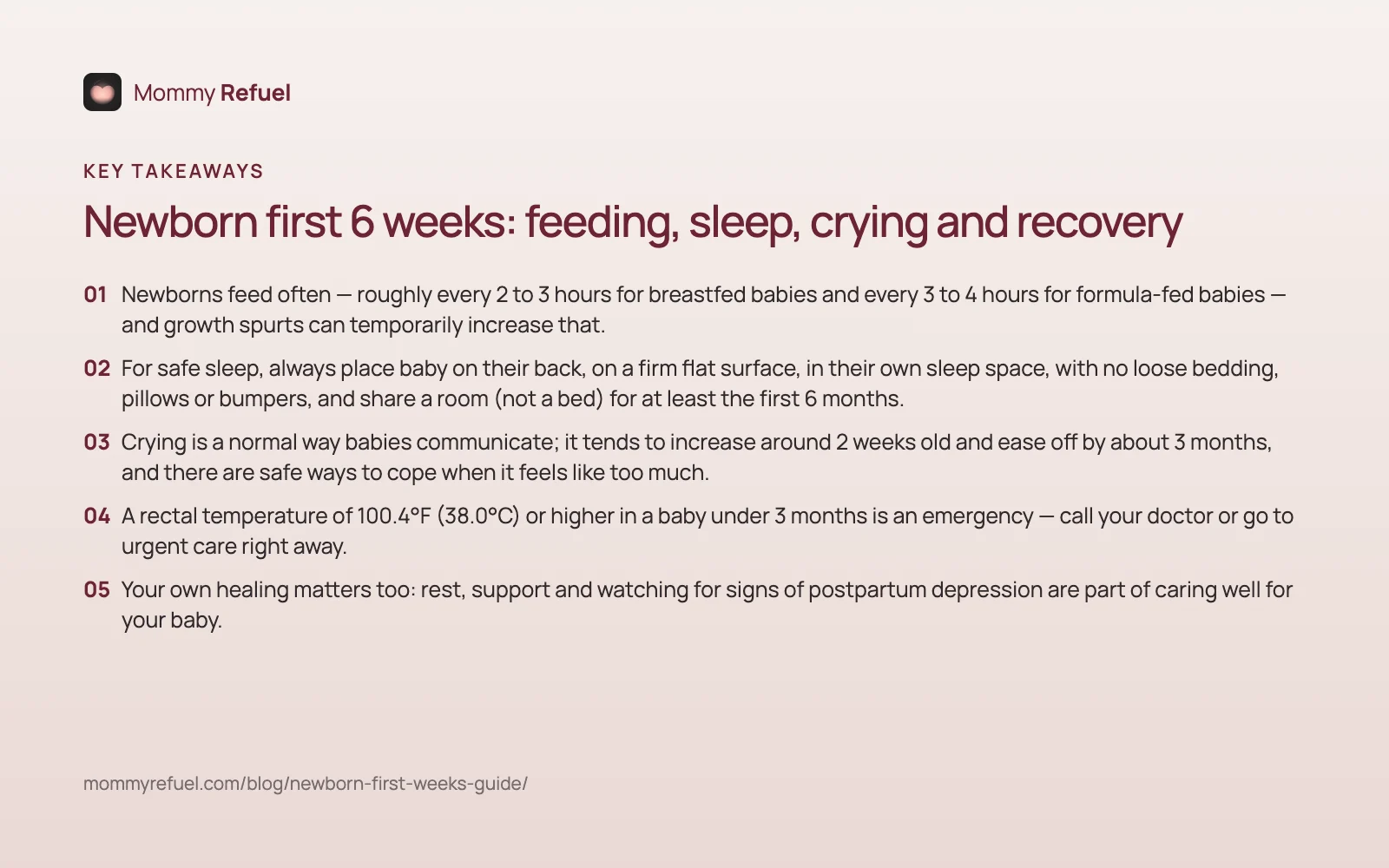
- Newborns feed often — roughly every 2 to 3 hours for breastfed babies and every 3 to 4 hours for formula-fed babies — and growth spurts can temporarily increase that.
- For safe sleep, always place baby on their back, on a firm flat surface, in their own sleep space, with no loose bedding, pillows or bumpers, and share a room (not a bed) for at least the first 6 months.
- Crying is a normal way babies communicate; it tends to increase around 2 weeks old and ease off by about 3 months, and there are safe ways to cope when it feels like too much.
- A rectal temperature of 100.4°F (38.0°C) or higher in a baby under 3 months is an emergency — call your doctor or go to urgent care right away.
- Your own healing matters too: rest, support and watching for signs of postpartum depression are part of caring well for your baby.
How often does a newborn need to feed?
Newborns have tiny stomachs and fast metabolisms, so frequent feeding is normal and expected, not a sign that something is wrong. Most breastfed newborns feed about 8 to 12 times in 24 hours, roughly every 2 to 3 hours, while formula-fed babies often go a little longer, around every 3 to 4 hours, because formula digests more slowly.
Rather than watching the clock, it helps to learn your baby's early feeding cues: rooting toward your hand or chest, bringing hands to the mouth, smacking or licking lips, and general restlessness. Crying is usually a later, more urgent hunger signal, so feeding at the earlier cues can make feeds calmer for both of you.
Expect growth spurts, often around 2 to 3 weeks and again around 6 weeks, when your baby may want to feed more frequently for a few days. This is normal and usually settles back into a rhythm on its own. If you are ever worried about weight gain, wet diapers or feeding itself, your pediatrician, midwife or a lactation consultant can check things properly — this article is general information, not a substitute for that kind of individual guidance.
Safe sleep basics for the first weeks
Sudden infant death syndrome (SIDS) risk is highest in the early months, and the good news is that a few consistent habits meaningfully lower the risk. The American Academy of Pediatrics recommends:
- Back to sleep. Always place your baby on their back for every nap and every night, not on their side or stomach.
- A firm, flat sleep surface. A crib, bassinet or play yard that meets current safety standards — never a sofa, armchair, adult bed or an inclined sleeper.
- Baby's own sleep space. Room-sharing (baby's crib in your room) for at least the first 6 months is recommended, but bed-sharing is not — it raises the risk of suffocation and SIDS.
- Keep the sleep area bare. No pillows, loose blankets, crib bumpers or soft toys. A fitted sheet is all you need; use a wearable blanket if you want extra warmth.
- No smoke exposure. Keep baby's environment smoke-free, during pregnancy and after birth.
- Avoid overheating. Dress baby in one layer more than you would wear, and watch for sweating or a hot chest as signs they are too warm.
These habits feel repetitive in the first weeks, but each one lowers risk in a real, well-documented way.
Is this much crying normal — and how do I cope?
Crying is simply how a newborn communicates before they have any other way to. It usually means hunger, a wet or dirty diaper, tiredness, wanting to be held, or general overstimulation. According to the NHS, the amount babies cry tends to increase from around 2 weeks old and then gradually reduces by about 3 months, which can make the early weeks feel especially intense even when nothing is wrong.
A few things that often help: offering a feed, changing the diaper, holding baby skin-to-skin, swaddling snugly, gentle rocking or a walk, white noise, or simply a change of scene. Sometimes nothing works right away, and that is not a reflection of your skill as a parent — some crying is simply not soothable in the moment.
If you feel yourself getting overwhelmed, it is safe and sensible to place your baby on their back in their crib, step into another room for a few minutes, and let yourself breathe. A calm parent returning after a short break is far better for a baby than a parent who never gets a moment to reset. If crying sounds different from usual, is constant, or you cannot console your baby at all, treat it as a reason to contact your doctor — see the red flags below.

When to call a doctor: red flags in the first weeks
Newborns can become unwell quickly, so it is worth knowing the key warning signs.
Fever is the headline one. For a baby younger than 3 months, a rectal temperature of 100.4°F (38.0°C) or higher is considered an emergency — call your doctor immediately or go to urgent care, even if your baby otherwise seems okay. Young infants cannot fight infection the way older babies can, so this threshold is taken seriously regardless of other symptoms.
Other signs that call for prompt medical attention include:
- Feeding poorly or refusing several feeds in a row
- Unusually sleepy, limp, or hard to wake for feeds
- Breathing that is fast, labored, grunting, or pauses
- Jaundice (yellowing of skin or eyes) that is spreading or getting more yellow, not less
- Noticeably fewer wet diapers than usual
- Inconsolable crying that sounds different from their normal cry
Trust your instincts. You know your baby's usual patterns better than anyone, and if something feels off, it is always reasonable to call your pediatrician, midwife or health visitor rather than wait.
Your own recovery matters too
The first weeks are framed entirely around the baby, but your own body and mind are also recovering from birth, whichever way your baby arrived. The NHS notes that bleeding, soreness, and tiredness are common in the weeks after birth, and healing takes real rest, not just willpower — sleeping when you can, staying hydrated, eating regularly and accepting practical help all support that healing.
Mood changes are common too. Many parents feel tearful, anxious or overwhelmed in the first couple of weeks, sometimes called the baby blues, and this usually eases on its own. If low mood, anxiety, or feeling disconnected from your baby lasts more than two weeks, or gets worse rather than better, that is a sign to talk to your doctor, midwife or health visitor about postpartum depression — it is common, treatable, and not a reflection of how much you love your baby.
Asking for help early, rather than waiting until you are depleted, is one of the most protective things you can do in these weeks.
Finding a rhythm that works for your family
There is no single correct schedule in the first six weeks — every baby and every recovery looks a little different, and what matters most is safety, feeding, and getting through each day with enough support. Many parents find it useful to jot down feeding times, sleep stretches and their own mood for a few days; patterns that are invisible day to day often become obvious once you can look back at them. A quick daily journal and insights habit can make those patterns easier to spot without adding real effort to already full days.
It also helps to name, specifically, what kind of support would make the biggest difference this week — an extra hour of sleep, a home-cooked meal, someone to hold the baby while you shower — and ask for exactly that. Mommy Refuel's Ask for Help feature is built for turning that vague need into a clear request you can send to someone you trust.
Above all, this stretch is genuinely temporary. It will not always feel this consuming, and getting support now is not a shortcut — it is part of doing this well.
Questions mothers ask
How many times a day should a newborn feed?
Most breastfed newborns feed 8 to 12 times in 24 hours, roughly every 2 to 3 hours, while formula-fed babies often feed every 3 to 4 hours. Following your baby's hunger cues matters more than a strict schedule.
Is it safe to room-share instead of bed-share?
Yes — the AAP recommends room-sharing, with your baby's crib or bassinet in your room, for at least the first 6 months. This is different from bed-sharing, which increases the risk of suffocation and SIDS and is not recommended.
When does newborn crying peak?
According to the NHS, crying tends to increase from around 2 weeks old and then gradually eases by about 3 months. It is a normal, if exhausting, part of early development.
What temperature counts as a fever emergency in a newborn?
For a baby under 3 months old, a rectal temperature of 100.4°F (38.0°C) or higher is an emergency. Call your doctor immediately or seek urgent care, even if your baby seems otherwise well.
How is the baby blues different from postpartum depression?
Baby blues are common in the first two weeks and usually pass on their own. If low mood, anxiety, or feeling disconnected from your baby lasts longer than two weeks or worsens, talk to your doctor, midwife or health visitor about postpartum depression.
Sources

Articles from the Mommy Refuel team: practical, honest reading on maternal wellbeing and family life. General information, never a substitute for professional care.
This article is general information for wellbeing, not medical advice, diagnosis or treatment. If you are worried about your health or your baby’s, talk to your doctor, midwife or health visitor. In an emergency, or if you have thoughts of harming yourself, contact local emergency services now.