
Key takeaways
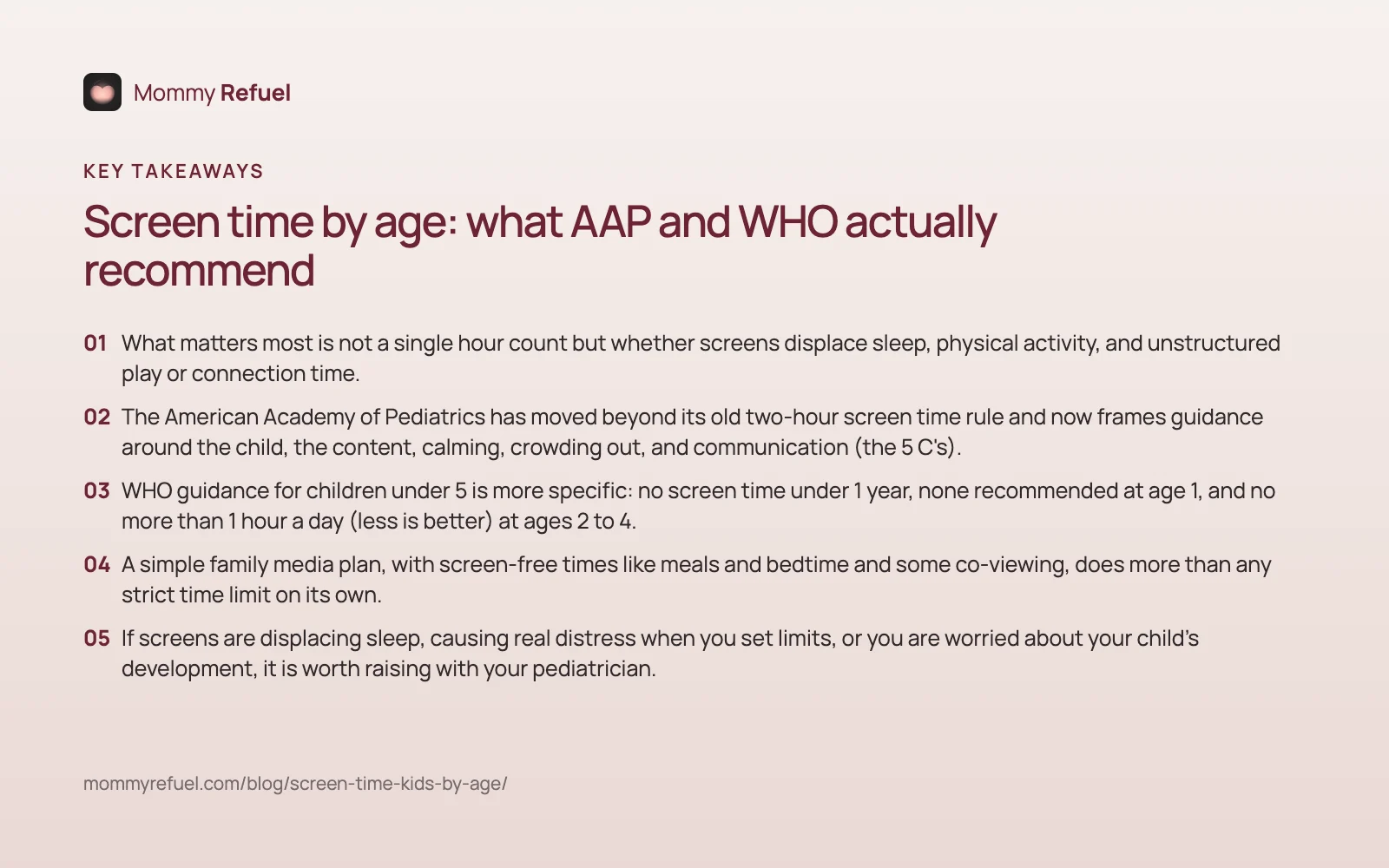
- What matters most is not a single hour count but whether screens displace sleep, physical activity, and unstructured play or connection time.
- The American Academy of Pediatrics has moved beyond its old two-hour screen time rule and now frames guidance around the child, the content, calming, crowding out, and communication (the 5 C's).
- WHO guidance for children under 5 is more specific: no screen time under 1 year, none recommended at age 1, and no more than 1 hour a day (less is better) at ages 2 to 4.
- A simple family media plan, with screen-free times like meals and bedtime and some co-viewing, does more than any strict time limit on its own.
- If screens are displacing sleep, causing real distress when you set limits, or you are worried about your child's development, it is worth raising with your pediatrician.
Why does screen time guidance exist?
Screen time guidance is not about screens being inherently bad. It exists because a child's day only has so many hours, and time spent on a screen is time not spent sleeping, moving, playing, or interacting face to face, all of which matter a great deal for young development.
Research that underpins pediatric guidance points to a few consistent themes: screens used late in the day can push back bedtime and interfere with the wind-down before sleep; time on a screen is time not spent in active play; and heavy reliance on screens to settle big feelings can get in the way of children learning to self-regulate on their own. Content quality also matters as much as, or more than, raw quantity. A calm co-viewed episode of an educational show is a very different experience from unsupervised, fast-cut video feeds.
None of this means the occasional screen-heavy day is a problem. It means the goal is balance over time, not a perfect daily number.
What does the AAP recommend by age?
For years, the American Academy of Pediatrics' most quoted rule was a flat limit: one hour a day of high-quality programming for children 2 to 5, and a general two-hour ceiling beyond that. The AAP has since moved beyond that two-hour rule, explaining that counting hours is too blunt a tool to capture what actually matters about a child's relationship with media. In its place, HealthyChildren.org now frames guidance around five questions, known as the 5 C's: the child (their age and temperament), the content they are watching, whether screens are being used to calm them down, what the screen time is crowding out, and how the family communicates about media.
Applied by age, the practical picture still looks like this:
- Under 18 to 24 months: media such as cartoons or videos is not recommended, because infants and young toddlers cannot yet learn much from a screen. Video chatting with a loved one, such as FaceTime or a similar call, is the one exception the AAP calls out as beneficial for building relationships.
- 2 to 5 years: the focus shifts to choosing high-quality, age-appropriate programming and watching together when you can, so you can help your child understand what they are seeing rather than leaving them to watch alone.
- School age (6 and up): the AAP's guidance centers on making sure screens do not crowd out sleep, homework, physical activity, or time with family, and on keeping devices out of the bedroom at bedtime so children can settle their bodies and minds for sleep.
What does the WHO recommend for children under 5?
The World Health Organization's guidelines on physical activity, sedentary behaviour and sleep for children under 5 give more specific numbers than current AAP guidance, as part of a broader recommendation covering movement and sleep too:
- Under 1 year: screen time is not recommended at all.
- 1 year old: sedentary screen time, such as watching TV or videos or playing on a device, is not recommended.
- 2 to 4 years: sedentary screen time should be no more than 1 hour a day, and less is better.
The same WHO guidelines also recommend against restraining a young child in a stroller, high chair, or car seat for more than an hour at a time when it can be avoided, since long stretches of being sedentary and strapped in add up alongside screen time.

Building a family media plan that actually fits your life
A written or informal family media plan tends to work better than an unspoken rule, because everyone, including you, knows what to expect. A few practical building blocks:
- Screen-free times and zones. Meals and the hour before bedtime are two of the most protective times to keep screen-free, since they support both connection and sleep.
- Co-view when you can. Watching or playing together, even briefly, turns a screen into a shared activity and gives you a chance to talk about what your child is seeing.
- Choose quality over quantity. A slower-paced, age-appropriate show does more for a young child than a fast-cut feed of short videos, regardless of how much time is spent.
- Protect the wind-down before sleep. Devices out of the bedroom and off well before lights-out gives bodies and minds time to settle.
If your family's routines shift week to week, a shared view of what is actually happening helps more than a rule nobody remembers. Many parents find it easier to notice patterns, like screens creeping into bedtime on hard weeks, when they can see the week laid out on a family timeline rather than trying to hold it all in their head.
Practical rules that hold up day to day
Plans work better than one-off decisions made in the moment. A few things that make limits easier to keep, for you and your child:
- Be consistent. The same basic rule on most days is easier for a child to accept than a rule that changes depending on your mood or how tired you are.
- Give a warning before screen time ends. A heads-up a few minutes before turning something off reduces meltdowns far more than a sudden stop.
- Model the behavior you want. Children notice what parents do with devices as much as what they are told to do.
- Expect some pushback, and hold the line kindly. A child protesting a limit is normal and does not mean the limit is wrong.
Your own screen use matters too
This is not about guilt. Every parent checks a phone mid-meal or mid-play sometimes, and that is normal. But children do notice when a caregiver is present in the room but not really there, and modeling some of the same screen-free windows you ask of your child, such as during meals or the last part of the day, makes the family rule feel fair rather than one-sided.
If you notice you are reaching for your phone out of habit during moments meant for your child, that is worth a gentle look, not a harsh one. A quick, honest daily check-in on how present you felt that day can make the pattern easier to see than trying to judge it in the moment.
When to talk to your pediatrician
Mommy Refuel is a wellbeing app, not a medical service, and none of this is medical advice. It is worth raising screen use with your pediatrician if:
- Screen time is regularly displacing sleep, meals, or physical activity, despite your efforts to set limits.
- Setting or enforcing a limit leads to distress that feels out of proportion or hard to manage.
- You are concerned about your child's language, social, or developmental progress and wonder whether media use plays a role.
Your pediatrician knows your child and can help you figure out what is a normal phase and what is worth a closer look, which is something no general guideline, including this one, can do for you.
Questions mothers ask
How much screen time is okay for a 2-year-old?
WHO guidance recommends no more than 1 hour a day of sedentary screen time for 2 to 4-year-olds, with less being better. Current AAP guidance focuses less on a strict hour count and more on choosing high-quality content and watching together.
Is video chatting with grandparents okay for a baby?
Yes. The AAP specifically calls out video chatting, such as FaceTime, as a beneficial exception to its general recommendation against screen media for children under 18 to 24 months, because it supports real relationships.
Did the AAP change its screen time rules?
Yes. The AAP has moved beyond its long-standing two-hour daily screen time limit and moved to the 5 C's framework, which looks at the child, the content, calming, what is being crowded out, and family communication about media, rather than a single number.
What screen time rule matters most for school-age kids?
AAP guidance for school-age children centers on making sure screens do not crowd out sleep, homework, physical activity, or family time, and on keeping devices out of the bedroom at bedtime.
Should I worry about my own phone use around my kids?
Occasional phone checking is normal and not something to feel guilty about. Children do notice when a caregiver is present but distracted, so protecting a few screen-free windows, like meals, models the habits you are asking of your child.
Sources
- AAP / HealthyChildren.org — Kids & Screen Time: How to Use the 5 C's of Media Guidance
- AAP / HealthyChildren.org — 5 C's Questions to Ask for Infants
- AAP / HealthyChildren.org — 5 C's for Toddlers & Preschoolers
- AAP / HealthyChildren.org — 5 C's for School-Age Children
- WHO — To grow up healthy, children need to sit less and play more

Articles from the Mommy Refuel team: practical, honest reading on maternal wellbeing and family life. General information, never a substitute for professional care.
This article is general information for wellbeing, not medical advice, diagnosis or treatment. If you are worried about your health or your baby’s, talk to your doctor, midwife or health visitor. In an emergency, or if you have thoughts of harming yourself, contact local emergency services now.