
Key takeaways
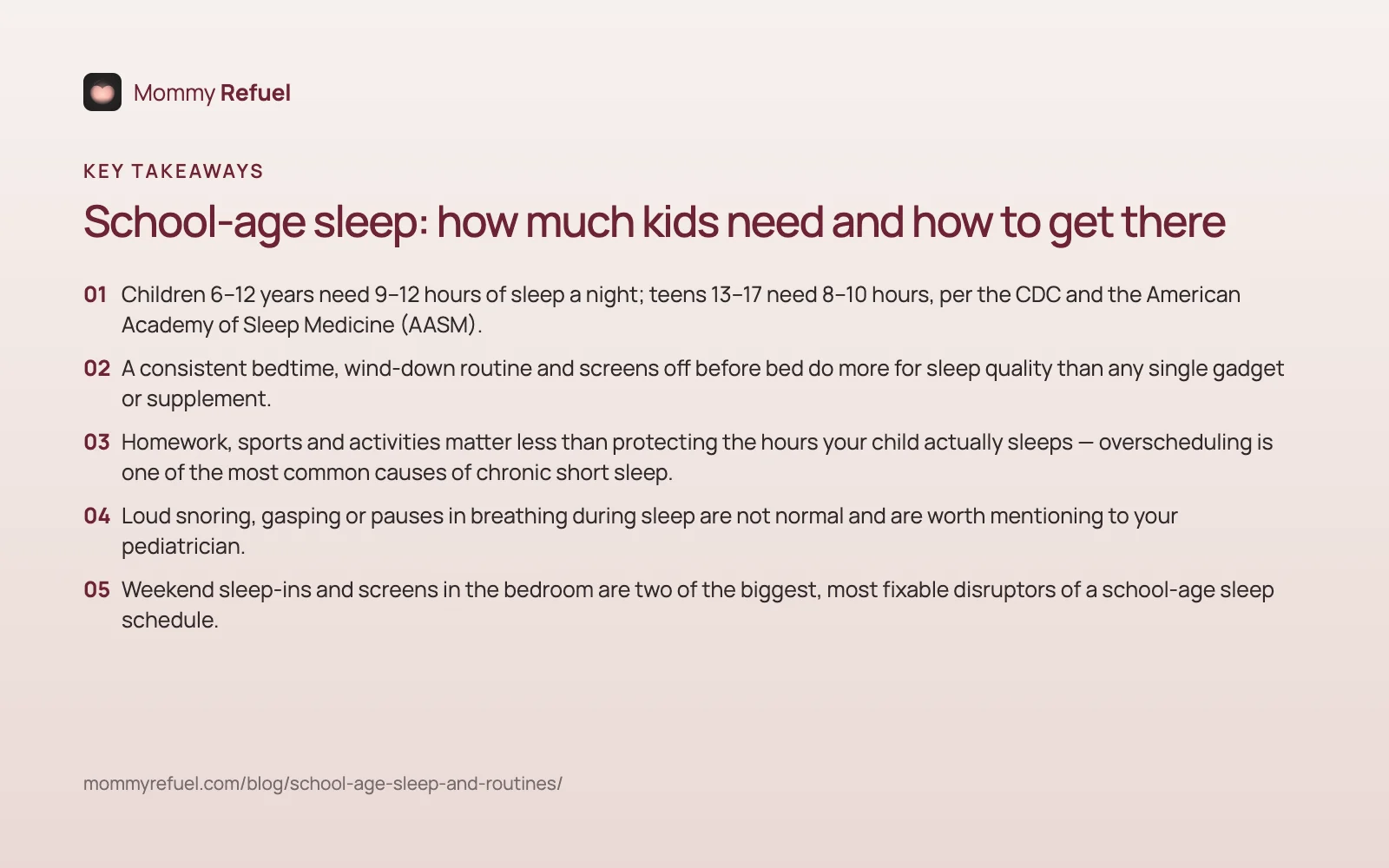
- Children 6–12 years need 9–12 hours of sleep a night; teens 13–17 need 8–10 hours, per the CDC and the American Academy of Sleep Medicine (AASM).
- A consistent bedtime, wind-down routine and screens off before bed do more for sleep quality than any single gadget or supplement.
- Homework, sports and activities matter less than protecting the hours your child actually sleeps — overscheduling is one of the most common causes of chronic short sleep.
- Loud snoring, gasping or pauses in breathing during sleep are not normal and are worth mentioning to your pediatrician.
- Weekend sleep-ins and screens in the bedroom are two of the biggest, most fixable disruptors of a school-age sleep schedule.
Why sleep matters so much at this age
Sleep is not downtime for a school-age child's brain and body — it is when a lot of the important work happens. During sleep, the brain consolidates what was learned that day, which is part of why well-rested kids tend to do better at school and remember more of what they practiced. Sleep also plays a role in regulating mood and behavior; short or fragmented sleep in children shows up as irritability, trouble focusing and lower frustration tolerance far more often than as obvious tiredness.
Physically, growth hormone is released mainly during deep sleep, and the immune system relies on adequate sleep to function well, which is part of why an overtired child seems to catch every cold going around. None of this requires a perfect night, every night — but a pattern of chronically short sleep adds up in ways that are easy to miss because kids rarely say "I'm tired," they just get harder to manage.
How many hours of sleep do school-age kids actually need?
The exact numbers matter more than most families expect, because "enough sleep" is often more than parents assume. Based on the CDC's sleep guidance and the American Academy of Sleep Medicine's Child Sleep Duration Health Advisory, endorsed by the American Academy of Pediatrics:
- Preschool (3–5 years): 10–13 hours per 24 hours, including naps.
- School age (6–12 years): 9–12 hours per 24 hours.
- Teens (13–17 years): 8–10 hours per 24 hours.
These are ranges, not a single magic number, and a child's needs can sit anywhere within the range. A reasonable working rule: if your child is hard to wake on school mornings, needs to be told more than once to get moving, or regularly naps or crashes on car rides home, that is often a sign they are getting less sleep than they need — even if bedtime looks "normal" on paper.
Building a bedtime routine that actually works
A consistent routine does more to protect sleep than almost anything else, because it signals to a child's body that sleep is coming, and it removes the nightly negotiation over when bedtime actually starts.
- Pick a bedtime and a wake time, and hold both steady — including on weekends, within about an hour. Consistency matters more than the exact time chosen.
- Start winding down 30–45 minutes before lights out. A short, predictable sequence — bath or wash-up, pajamas, reading, lights out — works better than trying to remember a long list each night.
- Screens off well before bed. Phones, tablets and TVs in the runup to bedtime make it harder to fall asleep, both because of the light and because of what's on the screen. Charging devices outside the bedroom overnight removes the temptation entirely.
- Keep the room cool, dark and quiet. Blackout curtains, a fan or white noise, and a consistent temperature all help kids fall asleep faster and stay asleep.
- Watch caffeine. Soda, some sports drinks, chocolate and iced tea all contain caffeine, and it can affect a child's sleep for longer than adults expect.
Balancing homework, activities and downtime without losing sleep
Sleep is usually what gets sacrificed first when a week gets busy — not because parents don't value it, but because homework has a deadline and sleep doesn't, until it does. A few practical adjustments help:
- Work backward from bedtime, not forward from the day's activities. If bedtime is 8:30, homework, dinner, bath and wind-down all need to fit before that, not compete with it.
- Be willing to say no to another activity. One or two after-school commitments a week is plenty for most school-age kids; a packed schedule that pushes dinner and homework later almost always pushes bedtime later too.
- Protect unstructured time. Downtime isn't wasted time — it lets kids wind down mentally before the bedtime routine even starts, which makes falling asleep easier.
- If homework regularly runs late, it's worth talking to the teacher about pacing rather than quietly trading away sleep every night.
Common sleep disruptors at this age
A few patterns show up again and again in school-age sleep problems:
- Irregular weekend schedules. Staying up late and sleeping in on weekends feels harmless, but it functions like mild jet lag and can make Monday mornings much harder.
- Screens or devices in the bedroom overnight. Even on silent, notifications and the temptation to check a device disrupt sleep.
- Caffeine later in the day, even in small amounts from soda or chocolate.
- School-related anxiety, which often shows up as trouble falling asleep, worries at bedtime, or waking overnight — this is common and usually responds well to a calm wind-down routine and a chance to talk through worries earlier in the evening, not right at lights-out.
- Overscheduling, covered above, which quietly eats into the hours available for sleep.
When to talk to your pediatrician
Occasional rough nights are normal. It's worth bringing up with your pediatrician if you notice:
- Persistent trouble falling asleep or staying asleep, most nights, for several weeks.
- Loud snoring, gasping, or pauses in breathing during sleep — these can be signs of sleep apnea and are worth mentioning even if your child seems to function fine during the day.
- Extreme daytime sleepiness despite what looks like enough time in bed.
- Noticeable changes in mood, behavior or school performance that seem tied to poor sleep.
This article is general information, not medical advice — your pediatrician can assess your child's specific situation and rule out or address underlying issues.
Keeping track of routines as a family
Bedtime routines are easier to hold steady when you can see the pattern rather than just remembering how last night went. Some families find it helpful to jot down bedtimes, wake-ups and how the week is actually going in a simple journal, or to place school and activity commitments on a shared family timeline so it's easier to spot when a week is getting too full before sleep starts slipping. In Mommy Refuel, this sits alongside the rest of your family's daily life rather than as a separate sleep tracker to manage.
Questions mothers ask
How many hours of sleep does a 7-year-old need?
A 7-year-old falls in the 6–12 years school-age band, which the CDC and AASM recommend gets 9–12 hours of sleep per 24 hours.
Is it okay for school-age kids to sleep in on weekends?
An hour or so of extra sleep is fine, but large swings between weekday and weekend sleep schedules act like mild jet lag and can make school mornings harder. Try to keep bedtime and wake time within about an hour of the weekday schedule.
Should kids have a TV, tablet or phone in their bedroom?
It's best avoided overnight. Screens in the bedroom, even on silent, are linked to shorter and more disrupted sleep in children. Charging devices in a common area overnight is a simple fix.
When should I worry about my child's sleep?
Talk to your pediatrician if trouble falling or staying asleep persists for several weeks, if you notice loud snoring, gasping or pauses in breathing, if your child is extremely sleepy during the day despite enough time in bed, or if mood or behavior changes seem tied to poor sleep.
Does homework or activities matter more than sleep?
No — chronic short sleep affects learning, memory and mood, which in turn affects how well a child actually performs at school and in activities. It's usually worth trimming a commitment rather than routinely trading away sleep.
Sources

Articles from the Mommy Refuel team: practical, honest reading on maternal wellbeing and family life. General information, never a substitute for professional care.
This article is general information for wellbeing, not medical advice, diagnosis or treatment. If you are worried about your health or your baby’s, talk to your doctor, midwife or health visitor. In an emergency, or if you have thoughts of harming yourself, contact local emergency services now.