
Key takeaways
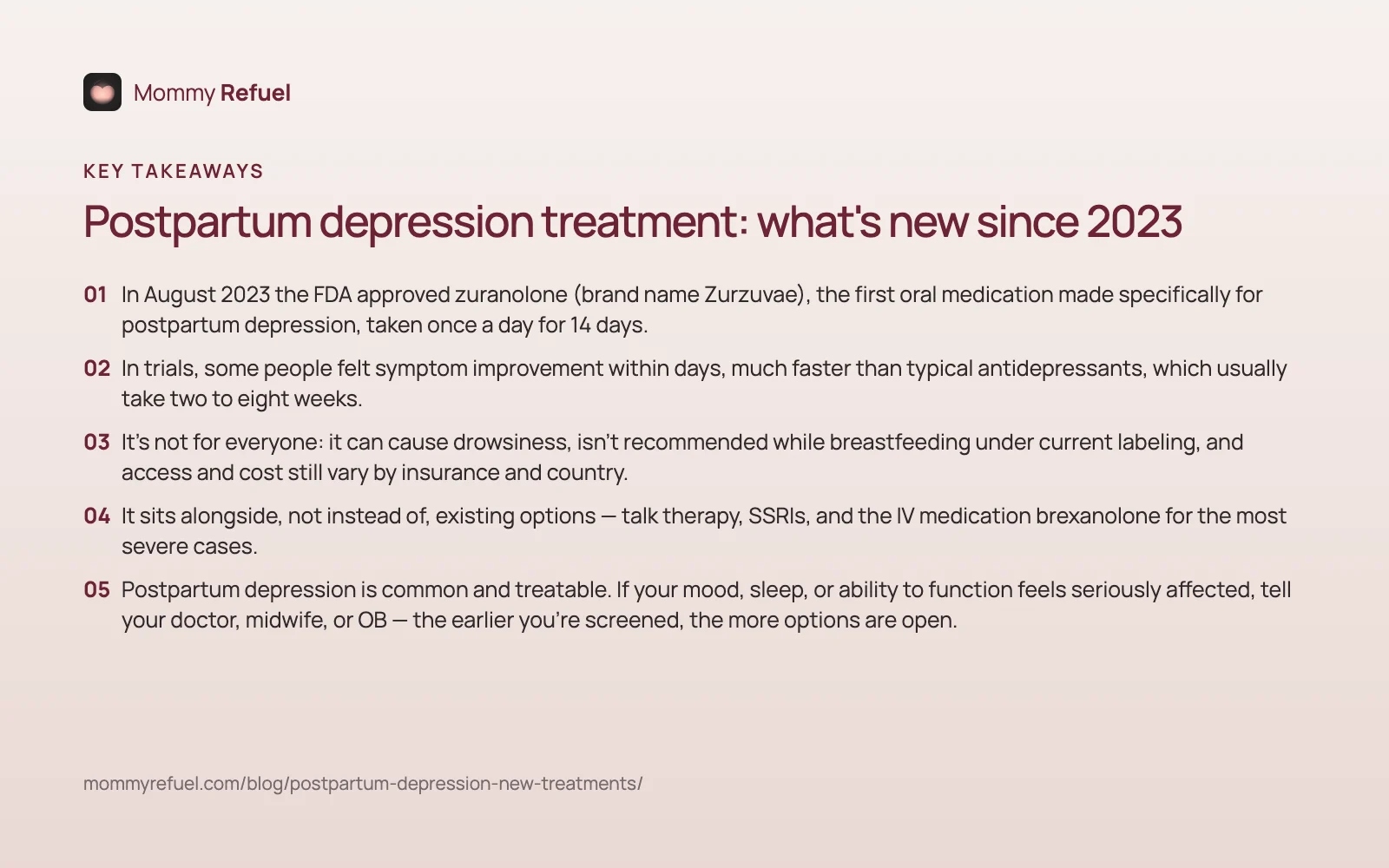
- In August 2023 the FDA approved zuranolone (brand name Zurzuvae), the first oral medication made specifically for postpartum depression, taken once a day for 14 days.
- In trials, some people felt symptom improvement within days, much faster than typical antidepressants, which usually take two to eight weeks.
- It's not for everyone: it can cause drowsiness, isn't recommended while breastfeeding under current labeling, and access and cost still vary by insurance and country.
- It sits alongside, not instead of, existing options — talk therapy, SSRIs, and the IV medication brexanolone for the most severe cases.
- Postpartum depression is common and treatable. If your mood, sleep, or ability to function feels seriously affected, tell your doctor, midwife, or OB — the earlier you're screened, the more options are open.
What actually changed in 2023?
For a long time, postpartum depression (PPD) was treated with the same antidepressants used for depression generally, mainly SSRIs, alongside therapy. In August 2023 the U.S. Food and Drug Administration approved zuranolone (brand name Zurzuvae), the first oral medication approved specifically for postpartum depression in adults. It became available by prescription in the U.S. in late 2023.
Zuranolone isn't a new class discovered overnight. It builds on an earlier IV medication, brexanolone (Zulresso), approved in 2019, which works on the same biological pathway but requires a 60-hour hospital infusion. Zuranolone was designed to bring a similar mechanism into a pill people can take at home.
How does zuranolone work, and how fast?
Zuranolone is a synthetic version of allopregnanolone, a hormone-derived compound that normally rises during pregnancy and drops sharply after birth. Researchers believe that drop plays a role in postpartum depression for some people. Zuranolone acts on GABA-A receptors in the brain, a pathway linked to mood regulation, rather than on serotonin, which is how SSRIs work.
The treatment course is one capsule a day for 14 days, not an ongoing daily medication. In the clinical trials that supported approval, some participants reported meaningful improvement in depressive symptoms within about three days, and the effect was measured again at day 15 and day 45. That speed is the main reason it drew attention: standard antidepressants typically take two to eight weeks to show a similar effect.
Who is it for, and what are the real limits?
Zuranolone is approved for adults with postpartum depression, prescribed and monitored by a clinician. A few practical limits matter:
- Drowsiness and driving. Because it can cause sedation and dizziness, people are advised not to drive or operate heavy machinery for at least 12 hours after each dose, and to take it in the evening with a fatty snack.
- Breastfeeding. Current prescribing information notes the medication passes into breast milk and safety for a nursing infant hasn't been established, so this is something to discuss carefully with your clinician if you're breastfeeding.
- Cost and access. As an oral medication it avoids a hospital stay, but price and insurance coverage still vary, and it may not be available or affordable everywhere.
- It's not a cure-all. Like other PPD treatments, it doesn't work identically for everyone, and some people need a different medication, added therapy, or both.

What other treatments are still part of the picture?
Zuranolone is one option among several, not a replacement for the rest of postpartum depression care:
- Talk therapy, particularly cognitive behavioral therapy and interpersonal therapy, is a first-line treatment recommended by professional bodies such as ACOG, alone or combined with medication.
- SSRIs (like sertraline) remain a common, well-studied first choice, considered compatible with breastfeeding for many people, and are often the more accessible and lower-cost option.
- Brexanolone (Zulresso), the IV version, is still used for more severe cases where a supervised hospital infusion makes sense.
- Support that isn't medical — sleep, practical help, partner or family support, and peer or group support — consistently shows up in the research as protective, even though it isn't a substitute for treatment when depression is significant.
The right choice depends on symptom severity, breastfeeding plans, what's accessible where you live, and your own history — which is exactly why a conversation with your doctor or midwife matters more than any single headline.
How is postpartum depression actually diagnosed?
Postpartum depression is usually identified through screening — a short questionnaire, often the Edinburgh Postnatal Depression Scale, that many clinics use at postpartum checkups — combined with a conversation about your symptoms, their duration, and how they affect daily life. It's different from the short-lived "baby blues," which usually fades within two weeks. PPD symptoms that last longer, feel more intense, or come with thoughts of hopelessness or not wanting to be around your baby deserve a proper conversation with a professional, not self-diagnosis from a checklist online.
Screening can happen at any postpartum visit, and you can also ask for it directly if nobody brings it up. Many people are never asked and don't realize how common PPD is — it affects a meaningful share of new mothers, and it's treatable.
When should you reach out for help?
Reach out to your doctor, midwife, or a mental health professional if, most days for more than two weeks, you notice: persistent sadness, emptiness, or irritability; loss of interest in things you used to enjoy; trouble bonding with your baby; overwhelming guilt or feeling like a failure; big changes in appetite or sleep beyond what a newborn explains; or difficulty concentrating or making decisions.
If you ever have thoughts of harming yourself or your baby, this is a medical emergency — contact emergency services, go to the nearest emergency department, or call a crisis line immediately. You are not a bad parent for feeling this way, and asking for help is the responsible, protective thing to do for both you and your baby.
How can you keep track of how you're doing?
Because postpartum depression can build gradually, it helps to have something more concrete than memory to look back on. Mommy Refuel is a free iPhone app with a short daily check-in for mood, sleep, and energy, so patterns are easier to spot and easier to describe at your next appointment. It's a reflection tool, not a diagnostic one — it doesn't replace screening or treatment, but it can make the conversation with your clinician more concrete.
Questions mothers ask
What is zuranolone (Zurzuvae) exactly?
It's the first oral medication approved by the FDA specifically for postpartum depression in adults, taken once daily for 14 days. It was approved in August 2023 and became available by prescription later that year.
How fast does it work compared to regular antidepressants?
In clinical trials, some participants showed improvement in depressive symptoms within about three days, compared with the two to eight weeks typical SSRIs usually take. Individual response varies.
Can I take zuranolone while breastfeeding?
Current prescribing information notes the medication passes into breast milk and safety for a nursing infant hasn't been established. Talk to your prescriber about your specific situation before deciding.
Is zuranolone the only treatment for postpartum depression?
No. Talk therapy and SSRIs remain common, well-studied first-line options, and the IV medication brexanolone is still used for more severe cases. Treatment is individualized.
How do I know if what I'm feeling is postpartum depression?
If low mood, anxiety, loss of interest, or trouble functioning last more than two weeks and feel more intense than typical newborn exhaustion, ask your doctor or midwife for a screening — you don't need to wait to be asked.
Sources

Articles from the Mommy Refuel team: practical, honest reading on maternal wellbeing and family life. General information, never a substitute for professional care.
This article is general information for wellbeing, not medical advice, diagnosis or treatment. If you are worried about your health or your baby’s, talk to your doctor, midwife or health visitor. In an emergency, or if you have thoughts of harming yourself, contact local emergency services now.