
Key takeaways
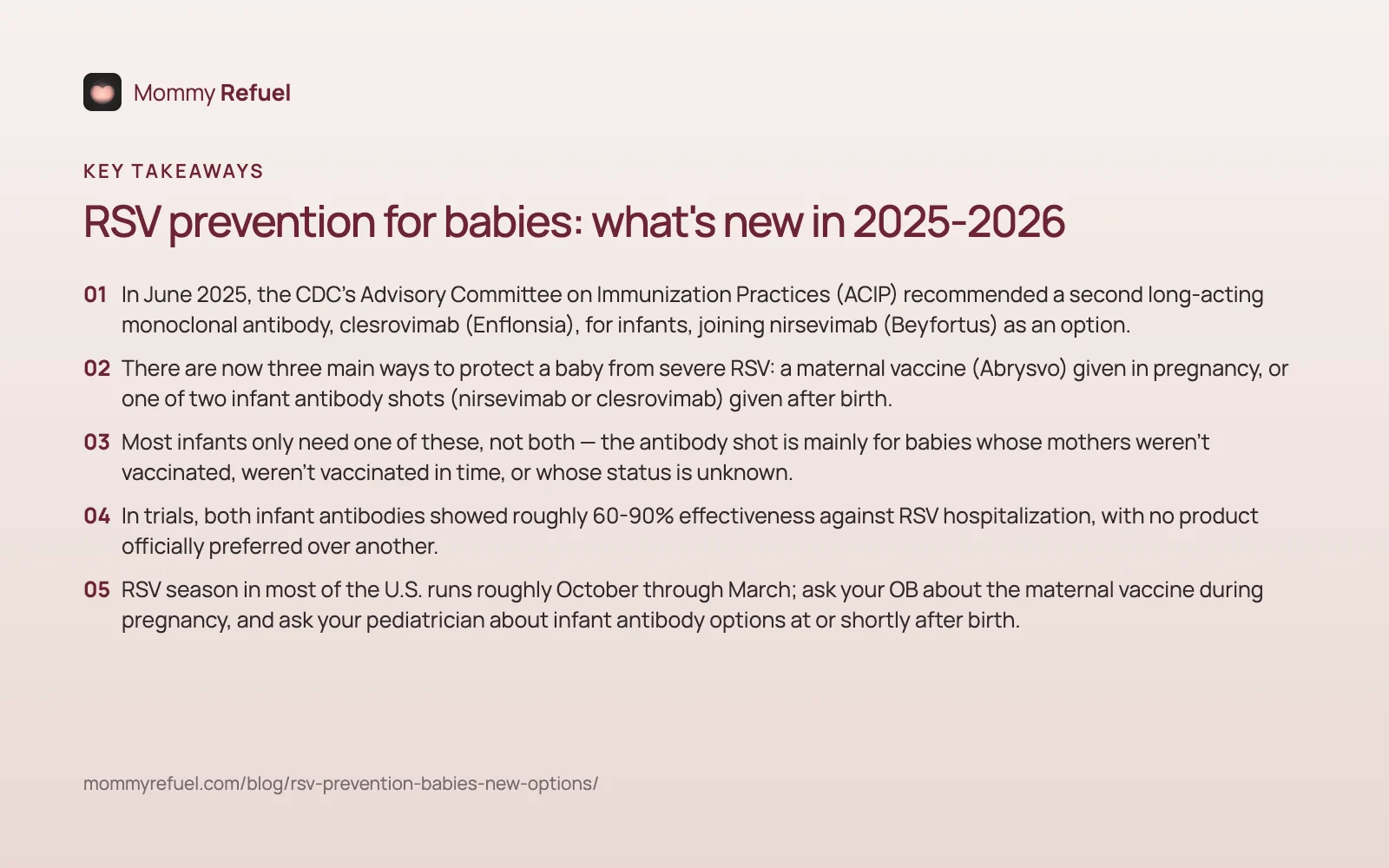
- In June 2025, the CDC's Advisory Committee on Immunization Practices (ACIP) recommended a second long-acting monoclonal antibody, clesrovimab (Enflonsia), for infants, joining nirsevimab (Beyfortus) as an option.
- There are now three main ways to protect a baby from severe RSV: a maternal vaccine (Abrysvo) given in pregnancy, or one of two infant antibody shots (nirsevimab or clesrovimab) given after birth.
- Most infants only need one of these, not both — the antibody shot is mainly for babies whose mothers weren't vaccinated, weren't vaccinated in time, or whose status is unknown.
- In trials, both infant antibodies showed roughly 60-90% effectiveness against RSV hospitalization, with no product officially preferred over another.
- RSV season in most of the U.S. runs roughly October through March; ask your OB about the maternal vaccine during pregnancy, and ask your pediatrician about infant antibody options at or shortly after birth.
Why does RSV get this much attention for babies?
Respiratory syncytial virus (RSV) is a common respiratory virus that's usually mild in older children and adults but can cause serious lower respiratory tract infections, like bronchiolitis or pneumonia, in very young infants. It's a leading cause of hospitalization in babies under a year old. Until recently, there was no way to directly protect infants beyond general hygiene and, for high-risk babies, a monthly antibody injection through the whole season. That changed with a maternal vaccine and then long-acting antibody shots that need only a single dose.
What are the three prevention options now?
- Maternal RSV vaccine (Abrysvo). Given to the pregnant parent, typically between weeks 32 and 36 of pregnancy, during RSV season. The vaccine prompts the mother's body to make antibodies that cross the placenta and protect the baby from birth.
- Nirsevimab (Beyfortus). A single long-acting monoclonal antibody injection given directly to the infant, ideally at birth or shortly after, that provides several months of passive protection through one RSV season.
- Clesrovimab (Enflonsia). A newer long-acting monoclonal antibody for infants, recommended by ACIP in June 2025 as a second antibody option alongside nirsevimab.
All three work by giving the baby ready-made antibodies rather than asking their immune system to build a response from scratch, which is why they can protect newborns whose own immune systems are still immature.
Does my baby need the vaccine, the antibody, or both?
Current CDC guidance is clear that most infants will not need both maternal vaccination and an infant antibody. An infant antibody (nirsevimab or clesrovimab) is generally recommended for infants younger than 8 months who are born during or entering their first RSV season, when: the mother did not receive the RSV vaccine during pregnancy; the mother's vaccination status is unknown; or the baby was born within 14 days of the mother's vaccination, which isn't enough time for protective antibodies to transfer fully. If the mother was vaccinated in time, the baby typically doesn't need the extra antibody shot for that first season.
This is a conversation to have with your OB before birth and with your pediatrician at or after delivery, since eligibility depends on timing and season, not just a blanket rule.

How well do these actually work?
Based on published data, nirsevimab has shown roughly 70-80% effectiveness against RSV-associated hospitalization in real-world use. Clesrovimab, in the trial supporting its 2025 recommendation, showed about 60% efficacy against medically attended RSV lower respiratory infections and around 91% efficacy against RSV-related hospitalization, with a safety profile similar to placebo. ACIP has not stated a preference between nirsevimab and clesrovimab — the choice generally comes down to what's available, timing, and your pediatrician's practice.
When does this matter during the year?
RSV circulates seasonally in most of the U.S., roughly October through March, similar to flu season. Infant antibody doses are typically given during this window, ideally during the birth hospitalization for babies born in season, or as a catch-up dose before season starts for babies born earlier in the year. If you're pregnant and due around RSV season, ask about vaccine timing at a prenatal visit rather than after the fact, since the 32-36 week window is specific.
What about symptoms and when to seek care?
Prevention lowers risk but doesn't eliminate it, so it still helps to know the warning signs of a serious respiratory infection in a young infant: fast or labored breathing, flaring nostrils, ribs pulling in with each breath, a bluish tint to lips or face, poor feeding, unusual lethargy, or a high fever in a very young baby. These need urgent medical attention regardless of whether your baby received an RSV vaccine or antibody, since protection is strong but not absolute.
How can you keep track of what your baby's had?
Between vaccines, antibody doses, and well-child visits, it's easy to lose track of exactly what was given and when, especially with a newborn and very little sleep. Mommy Refuel, a free iPhone app for the whole parenting journey, includes tools like doctor visit summaries to help you keep notes and questions organized between appointments. It's not a medical record system and doesn't replace your pediatrician's own documentation, but it can make follow-up conversations easier.
Questions mothers ask
What's new about RSV prevention for babies in 2025-2026?
In June 2025, ACIP recommended clesrovimab (Enflonsia) as a second long-acting monoclonal antibody for infants, giving families a choice alongside the existing nirsevimab (Beyfortus) and the maternal vaccine Abrysvo.
Does my baby need both the maternal vaccine and an antibody shot?
Usually not. Most infants need only one form of protection. An infant antibody is mainly recommended when the mother wasn't vaccinated in time, wasn't vaccinated, or her status is unknown.
Is nirsevimab or clesrovimab better?
Health authorities haven't stated a preference between the two. Both are long-acting monoclonal antibodies with strong trial data against RSV hospitalization; the choice often comes down to availability and your pediatrician's practice.
When should the maternal RSV vaccine be given?
Typically between weeks 32 and 36 of pregnancy, during RSV season, so protective antibodies have time to cross to the baby before birth. Ask your OB about exact timing.
What symptoms in a baby need urgent care, even after RSV prevention?
Fast or labored breathing, flaring nostrils, ribs pulling in with breathing, bluish lips or face, poor feeding, unusual lethargy, or high fever in a young infant all need prompt medical attention, since no prevention method is 100% protective.
Sources

Articles from the Mommy Refuel team: practical, honest reading on maternal wellbeing and family life. General information, never a substitute for professional care.
This article is general information for wellbeing, not medical advice, diagnosis or treatment. If you are worried about your health or your baby’s, talk to your doctor, midwife or health visitor. In an emergency, or if you have thoughts of harming yourself, contact local emergency services now.