
Key takeaways
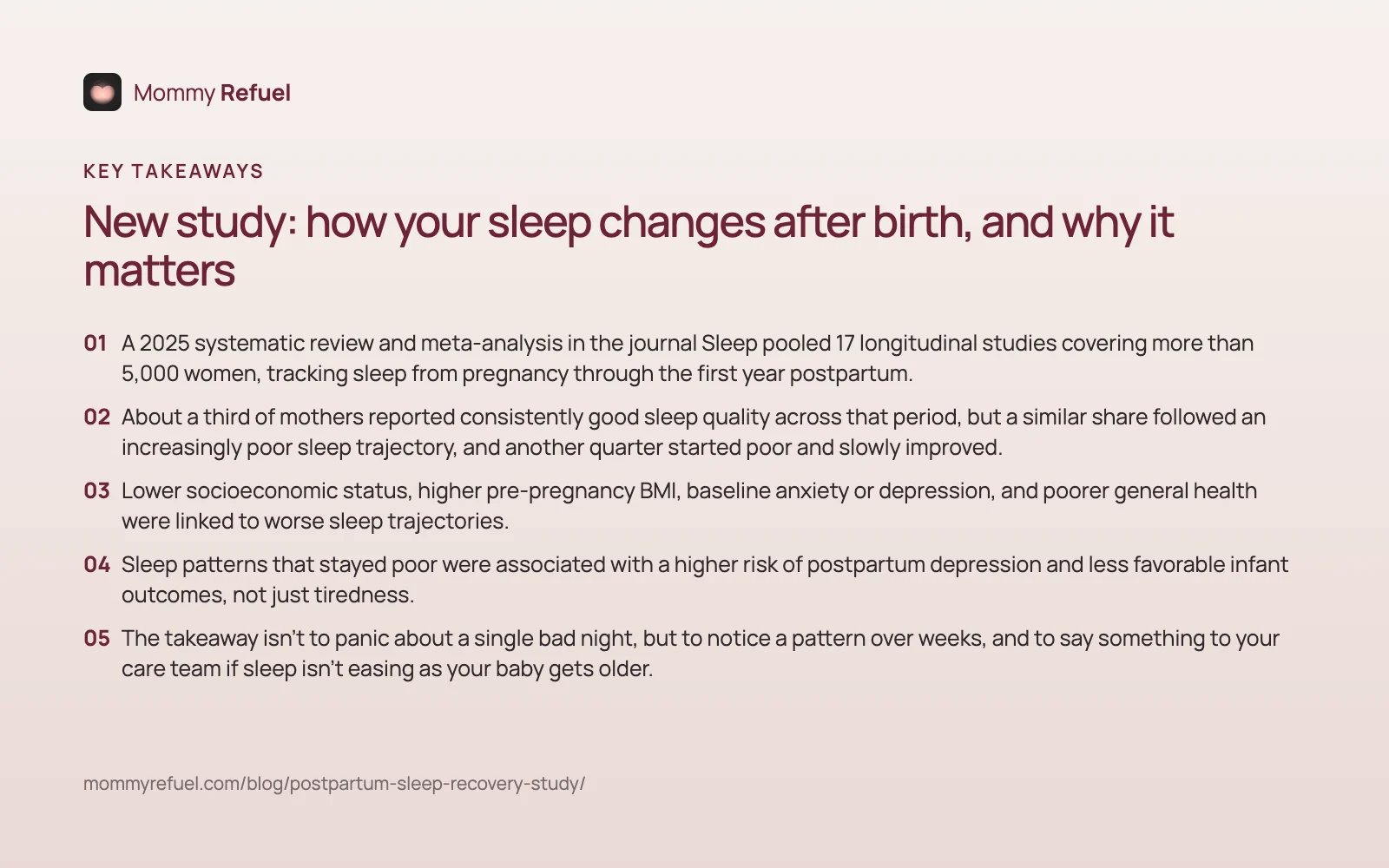
- A 2025 systematic review and meta-analysis in the journal Sleep pooled 17 longitudinal studies covering more than 5,000 women, tracking sleep from pregnancy through the first year postpartum.
- About a third of mothers reported consistently good sleep quality across that period, but a similar share followed an increasingly poor sleep trajectory, and another quarter started poor and slowly improved.
- Lower socioeconomic status, higher pre-pregnancy BMI, baseline anxiety or depression, and poorer general health were linked to worse sleep trajectories.
- Sleep patterns that stayed poor were associated with a higher risk of postpartum depression and less favorable infant outcomes, not just tiredness.
- The takeaway isn't to panic about a single bad night, but to notice a pattern over weeks, and to say something to your care team if sleep isn't easing as your baby gets older.
What did this study actually look at?
Published in the journal Sleep in 2025, this systematic review and meta-analysis pooled data from 17 longitudinal studies that tracked women's sleep across pregnancy and into the first year after birth, searching the literature through August 2024. In total, the review covered just over 5,000 perinatal women, each assessed on sleep at three or more points in time, which is what makes it useful: instead of one snapshot, it shows how sleep actually moves over months, not just whether it's "bad" at any single check-in.
The researchers measured several sides of sleep, not just hours: overall quality, duration, efficiency (how much of the time in bed is actually spent asleep), bedtime timing, and clinical insomnia symptoms.
How common was poor sleep, really?
Across the pooled studies, the review found that poor sleep quality affected roughly a third of participants, nonoptimal sleep duration affected about a fifth, low sleep efficiency around 15%, delayed bedtime just over half, and clinical insomnia symptoms about 13%. In plain terms: disrupted sleep in the perinatal period is the norm, not a personal failing, which matches what most new parents already sense but rarely see quantified this clearly.
The more useful finding, though, wasn't the single-point prevalence. It was the pattern over time.
What were the three sleep patterns the study found?
The review identified three broad sleep quality trajectories across pregnancy and the postpartum year:
- Consistently good sleep (about 39% of participants) — sleep quality stayed reasonably stable and healthy throughout.
- Increasingly poor sleep (about 38%) — sleep quality started okay and gradually worsened over the months tracked.
- Decreasingly poor sleep (about 24%) — sleep started difficult, often right after birth, and slowly improved.
In other words, roughly six in ten mothers experienced a meaningfully rocky sleep trajectory at some point, and for a large share of that group, things got harder over time rather than easing on their own. That's worth knowing, because the common assumption is that sleep just gradually gets better as a baby grows — for a sizable group in this review, it didn't, at least not without something changing.
Who was more likely to have a difficult sleep trajectory?
The review identified several factors linked to worse sleep trajectories: lower socioeconomic status, higher pre-pregnancy BMI, existing anxiety or depression symptoms before or early in the perinatal period, and poorer general health status. None of these are things a person chooses, which matters — it reframes struggling sleep less as a discipline problem and more as something shaped by circumstances and health history, some of which a care team can actually help with.
Why does the sleep pattern matter beyond feeling tired?
The review linked nonoptimal sleep trajectories to a higher risk of postpartum depression and to less favorable infant outcomes. This lines up with a broader body of research on the two-way relationship between maternal sleep and mental health: poor sleep can worsen mood, and low mood or anxiety can, in turn, disrupt sleep further, creating a loop that's hard to break without support.
This doesn't mean every tired mother will develop depression, or that one hard week points to a bigger problem. It means sleep is a reasonable thing to track and discuss at checkups, not just something to privately push through.
What can you realistically do with this information?
You can't rewrite your socioeconomic circumstances or undo a hard pregnancy, but a few things from this research are actionable:
- Notice the trend, not just the night. One rough night after a growth spurt or illness isn't the same as sleep steadily getting worse over weeks.
- Bring sleep up at postpartum visits, especially if it's not improving as your baby's own sleep matures — this is a legitimate topic for your doctor, midwife, or health visitor, not a minor complaint.
- Treat existing anxiety or low mood early, since the sleep-mood relationship runs both directions; addressing one can ease the other.
- Ask for practical support where you can — shared night shifts, help with other tasks, or professional support if things aren't easing.
How can you see your own sleep trend over time?
Since this research shows the trajectory matters more than any single night, having a simple ongoing record of your own sleep, mood, and energy can help you and your care team spot a pattern early. Mommy Refuel is a free iPhone app with a short daily check-in, and it can pull in sleep data from Apple Health through Apple integrations if you connect it, with weekly recovery reports that reflect what's changed. It's a personal reflection tool, not a diagnostic one, and it doesn't replace your care team.
Questions mothers ask
What did the 2025 sleep study actually study?
A systematic review and meta-analysis published in the journal Sleep pooled 17 longitudinal studies and over 5,000 women, tracking sleep quality, duration, efficiency, and insomnia symptoms from pregnancy through the first postpartum year.
Does postpartum sleep usually get better on its own?
For some mothers, yes — about a quarter of the study group started with poor sleep that gradually improved. But a similar-sized group saw sleep get worse over time rather than better, so improvement isn't guaranteed without support.
What increases the risk of a difficult sleep trajectory?
The review linked lower socioeconomic status, higher pre-pregnancy BMI, existing anxiety or depression, and poorer general health to worse sleep trajectories over the perinatal period.
Is poor postpartum sleep linked to postpartum depression?
The review found nonoptimal sleep trajectories were associated with a higher risk of postpartum depression. The relationship likely runs both ways: poor sleep can worsen mood, and low mood can disrupt sleep.
When should I mention my sleep to a doctor?
If your sleep isn't easing as your baby grows, or feels linked to low mood, anxiety, or exhaustion that doesn't lift with rest, bring it up at a postpartum visit rather than waiting to be asked.
Sources

Articles from the Mommy Refuel team: practical, honest reading on maternal wellbeing and family life. General information, never a substitute for professional care.
This article is general information for wellbeing, not medical advice, diagnosis or treatment. If you are worried about your health or your baby’s, talk to your doctor, midwife or health visitor. In an emergency, or if you have thoughts of harming yourself, contact local emergency services now.