
Key takeaways
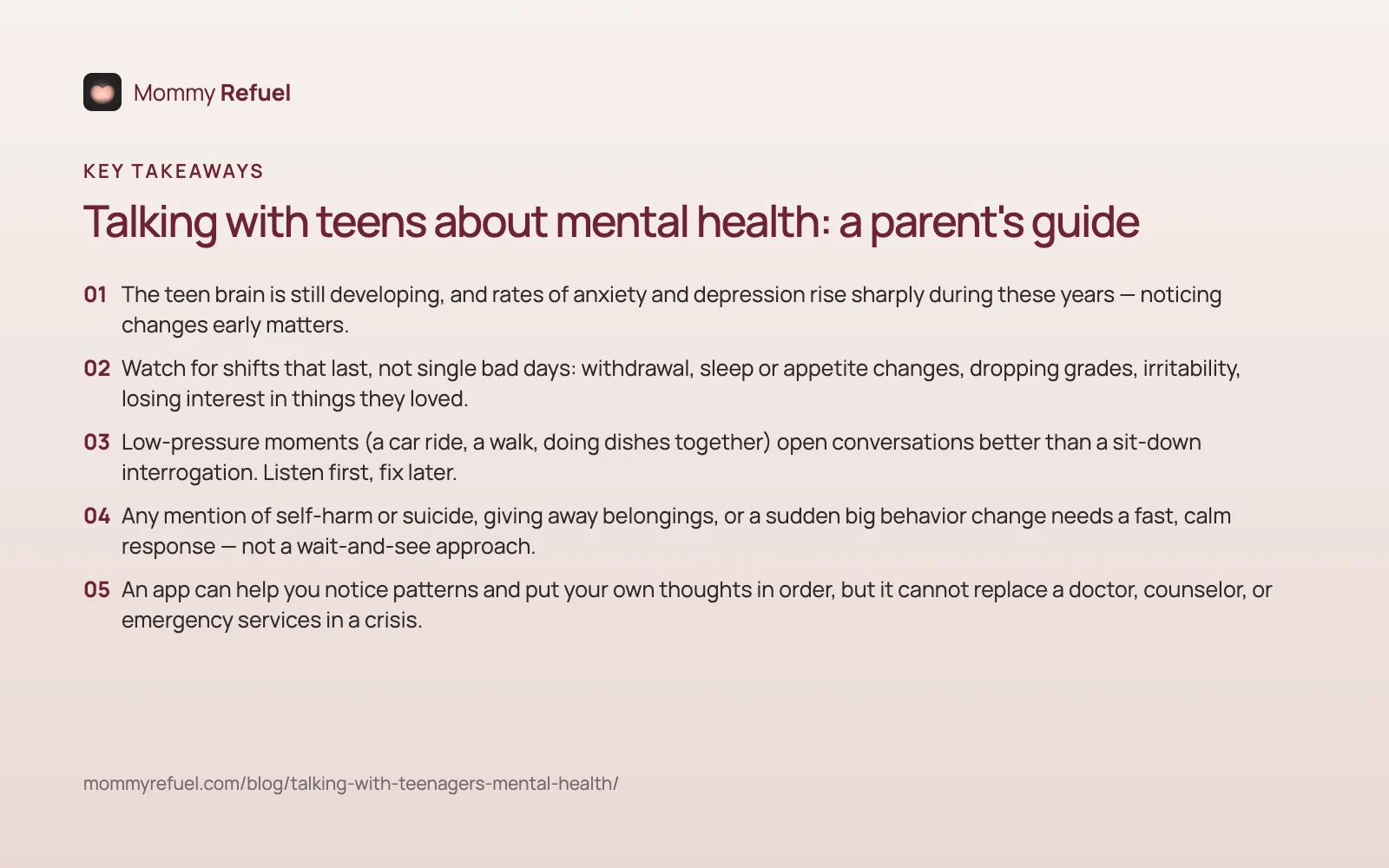
- The teen brain is still developing, and rates of anxiety and depression rise sharply during these years — noticing changes early matters.
- Watch for shifts that last, not single bad days: withdrawal, sleep or appetite changes, dropping grades, irritability, losing interest in things they loved.
- Low-pressure moments (a car ride, a walk, doing dishes together) open conversations better than a sit-down interrogation. Listen first, fix later.
- Any mention of self-harm or suicide, giving away belongings, or a sudden big behavior change needs a fast, calm response — not a wait-and-see approach.
- An app can help you notice patterns and put your own thoughts in order, but it cannot replace a doctor, counselor, or emergency services in a crisis.
Why the teen years are a different kind of hard
Something real is happening in a teenager's brain and body between roughly ages 12 and 18. The parts of the brain that handle planning, impulse control and weighing consequences are still maturing, while the parts that process emotion and reward are already running at full speed. That mismatch is a normal part of development, not a character flaw, and it helps explain why the same child who was easygoing at ten can seem moody, secretive or reactive at fourteen.
At the same time, teens are doing real developmental work: building an identity separate from their parents, testing independence, and figuring out where they fit with friends. National data shows this stage carries real mental health stakes. The American Academy of Pediatrics has flagged rising youth anxiety and depression as a public health concern, and the CDC's ongoing Youth Risk Behavior Survey has tracked a troubling long-term rise in persistent sadness and hopelessness among U.S. high school students over the past decade.
None of this means every teen is struggling, or that mood swings equal a mental health crisis. It means this stage deserves attention, patience and a parent who stays reachable even when the teenager does not make that easy.
What changes are worth noticing?
Teenagers are naturally more private and more changeable than younger kids, so the goal is not to police every mood. It is to notice patterns that last and stand out from how your teen usually is. Signals worth a gentle check-in include:
- Withdrawal. Pulling away from family, friends or activities they used to enjoy.
- Sleep or appetite changes. Sleeping much more or much less than usual, or noticeable changes in eating.
- Grades slipping. A real drop in schoolwork or a loss of interest in school itself.
- Loss of interest. Hobbies, sports or friendships that used to matter suddenly do not.
- Irritability. A shorter fuse, more conflict, or seeming easily overwhelmed by small things.
- Changes in friend groups. A sudden, unexplained shift in who they spend time with, or spending much more time completely alone.
None of these are a diagnosis on their own. They are signals to check in with curiosity, not to jump straight to conclusions.
How do I actually start the conversation?
Most teens do not respond well to a formal sit-down that feels like an interrogation. The American Academy of Pediatrics notes that with teenagers, it is often less about what you say and more about how well you listen. A few things that tend to help:
- Pick a low-pressure moment. Side-by-side time, like a car ride, cooking together or a walk, often works better than face-to-face questioning.
- Ask open questions. "How have you been feeling lately?" invites more than "Are you okay?", which is easy to answer with a reflexive "fine."
- Listen before you fix. Resist the urge to solve the problem in the first sixty seconds. Often teens need to feel heard before they can hear advice.
- Normalize hard feelings. Saying "it makes sense you'd feel stressed about that" tends to open things up more than "you shouldn't worry so much."
- Keep the door open, even after an awkward attempt. If a conversation goes nowhere, that is not failure. You can try again another day.
You do not need the perfect script. A consistent, calm willingness to ask again matters more than any single conversation.

Warning signs that need fast action
Some signs call for an immediate, calm response rather than a wait-and-see approach:
- Any mention of self-harm, suicide, wanting to die, or feeling like a burden to others.
- Giving away meaningful belongings, or talking about things as if wrapping them up.
- A sudden, significant change in behavior, mood or personality.
- Signs of substance use.
If you notice any of these, stay calm and stay close. Ask directly and gently, for example, "Are you having thoughts of hurting yourself?" Asking does not plant the idea; it opens the door for your teen to tell you what is really going on. Avoid reacting with panic, anger or minimizing what they share. Then move straight to getting them professional or emergency support, described below.
Getting help, wherever you are
If your teen is in immediate danger, contact emergency services right away. This is not something to handle alone, and it is not something an app or article can substitute for.
In Ukraine: call 103 for an ambulance, or 112, the unified emergency number that connects you to all emergency services. For emotional or suicidal crisis support, Lifeline Ukraine operates a free, confidential crisis line at 7333, available 24/7.
In the United States: the 988 Suicide & Crisis Lifeline offers free, confidential support by call or text to 988, 24 hours a day.
Wherever you are: if there is no local crisis line you know of, contact your local emergency services number, your family doctor or pediatrician, or your teen's school counselor. Many schools have a mental health professional who can assess next steps and point you toward local, age-appropriate care.
For non-urgent but ongoing concerns, a doctor or a licensed mental health professional who works with teens is the right next step. A tool like Ask for Help in Mommy Refuel can help you turn a vague worry into a clear, specific ask when you reach out to a partner, relative or professional, but it is a support for you as a parent, not a substitute for professional care for your teen.
Looking ahead to independence at 18
As your teen nears adulthood, the goal shifts gradually from managing their wellbeing to helping them manage it themselves. A few things that help over the last stretch of the teen years:
- Keep having supportive, low-pressure conversations rather than tapering off once things seem calmer.
- Walk through practical skills together: booking their own doctor's appointments, understanding their insurance or health coverage, knowing what to do and who to call in a crisis.
- If they are heading to college or moving out, talk about how healthcare will transition, including finding a new doctor or therapist if needed.
- Stay connected without over-controlling. Checking in regularly, without monitoring every detail, tends to keep the relationship — and the door for honest conversation — open longest.
You will not get every conversation right, and you do not need to. What matters most is that your teen knows you are steady, reachable and on their side.
Questions mothers ask
My teenager barely talks to me. How do I even start?
Try low-pressure, side-by-side moments like a car ride or cooking together rather than a formal talk. Ask open questions, listen more than you speak, and keep trying even if the first few attempts go nowhere.
Are mood swings in teenagers normal, or a sign of a problem?
Some moodiness is a normal part of teen brain development. It becomes worth a closer look when changes last for weeks, are a clear shift from how your teen usually is, or come with withdrawal, sleep changes or a drop in grades.
Should I take away my teen's phone if I'm worried about social media?
Evidence on social media and teen mental health is mixed, with both risks and benefits. A conversation about how specific content or habits make them feel, plus practical limits like no phones overnight, tends to work better than an outright ban.
What should I do if my teen mentions self-harm or suicide?
Stay calm, ask directly and gently whether they are having thoughts of hurting themselves, and take it seriously. Then get professional or emergency help right away — in Ukraine that means 103 or 112, or Lifeline Ukraine at 7333; in the US, call or text 988.
Can an app like Mommy Refuel help with my teen's mental health?
Mommy Refuel is built for your own wellbeing as a parent, not to assess or treat your teen. It can help you organize your thoughts and ask for support, but a doctor, counselor or crisis line is the right resource for your teen's mental health.
Sources
- HealthyChildren.org (AAP): Teen mental health — watch for danger signs
- HealthyChildren.org (AAP): How to communicate with a teenager
- AAP: Center of Excellence on Social Media and Youth Mental Health
- NIMH: Teen depression — more than just moodiness
- 988 Suicide & Crisis Lifeline — About
- Lifeline Ukraine — 7333 crisis line
- Cabinet of Ministers of Ukraine: how the unified 112 emergency number works

Articles from the Mommy Refuel team: practical, honest reading on maternal wellbeing and family life. General information, never a substitute for professional care.
This article is general information for wellbeing, not medical advice, diagnosis or treatment. If you are worried about your health or your baby’s, talk to your doctor, midwife or health visitor. In an emergency, or if you have thoughts of harming yourself, contact local emergency services now.



What about social media?
Social media's effect on teen mental health is genuinely mixed, and the evidence is more nuanced than headlines suggest. The American Academy of Pediatrics' Center of Excellence on Social Media and Youth Mental Health points out that social media can offer real benefits, like connection, identity exploration and support, alongside real risks, including exposure to harmful content, social comparison and disrupted sleep.
Rather than framing it as all good or all bad, it helps to talk with your teen about how a platform or habit makes them feel, not just how much time it takes. Useful angles for a conversation: Does scrolling leave you feeling better or worse afterward? Are there accounts or content that consistently bring your mood down? Is it affecting your sleep? Keeping phones out of the bedroom at night and agreeing on some tech-free times together are practical steps many families find useful, alongside an ongoing, judgment-free conversation rather than a one-time rule.